Blog

Our blog category

Blog

ibis India Moves Sustainability Into the Everyday Hotel Stay, From Water Bottles to Food Waste and Energy Use

ibis, one of India’s leading hotel brands, is strengthening its sustainability focus in the country by embedding responsible practices into the everyday running of its hotels. With a growing presence across the country and 22 ibis and ibis Styles hotels already Green Key certified, the brand is moving beyond certification-led sustainability to focus on the operational choices that shape a hotel stay. This extends to everyday operational choices, from how water is provided in guest rooms and breakfast is managed to how water and electricity are consumed, and waste is handled across its hotels.  ibis is integrating sustainability into its day-to-day hotel operations, with a focus on reducing resource consumption and waste across the guest journey. This includes replacing single-use plastic water bottles with reusable glass bottles, reducing food waste and incorporating local and seasonal ingredients where feasible. The brand is also focusing on responsible water and energy use, along with stronger waste segregation and recycling practices. The move assumes greater significance as India’s travel economy expands rapidly. The country recorded 4.29 billion domestic tourist visits in 2025, while tourism contributed an estimated 5.22% to India’s GDP and supported 84.63 million jobs. As the number of hotel stays, meals served, and travel-related consumption grows, the cumulative impact of everyday hospitality operations is becoming increasingly important to India’s sustainability agenda. For ibis, the focus is therefore on the areas where a hotel consumes resources every day. In food and beverage, the brand is working to reduce food waste and has incorporated measures such as eliminating single-use plastic from breakfast sideboards, using local and seasonal supplies where possible and promoting more responsible sourcing. In hotel operations, the focus extends to responsible water consumption, energy efficiency and reducing waste generated through routine activities. “The next phase of sustainable hospitality will be determined by what happens behind the scenes, not only by what guests see. A hotel operates continuously, with water being consumed in rooms, food being prepared and discarded, energy being used across multiple touchpoints and waste being generated throughout the day. The opportunity is to redesign these everyday processes so that the more responsible choice becomes part of the operation itself. At ibis, we are focusing on practical changes that can work at scale and become part of the normal guest experience rather than asking guests to choose between sustainability and convenience,” said Mr Deeppreet Bindra, Director, ibis & ibis Styles India.  ibis’ sustainability focus also extends beyond its hotel operations to on-ground environmental action and community engagement. In June 2026, ibis India launched a nationwide beach clean-up initiative across Mumbai, Goa, Chennai and Kochi, bringing together hotel teams, local NGOs, civic authorities and community volunteers to support cleaner coastlines and promote responsible waste management. The initiative reflects ibis India’s broader approach to sustainability, combining practical measures within its hotels with community-led efforts that contribute to cleaner and more responsible destinations.

Blog

Navi Mumbai Airport Adds Twice-Daily Jeddah Flights from December 15

Navi Mumbai International Airport is set to further expand its international network with the introduction of direct flights to Jeddah, Saudi Arabia, operated by Akasa Air, beginning December 15, 2026. The airline will operate twice-daily services on the route, providing passengers from the Mumbai Metropolitan Region  and surrounding areas with enhanced connectivity to one of Saudi Arabia’s key commercial and travel destinations. The new services will be operated using Boeing 737 MAX 8 aircraft, with a seating capacity of 197 passengers. Bookings for the flights are now open across major booking platforms. The introduction of the Jeddah route marks another step in NMIA’s expanding international connectivity, offering greater travel convenience to passengers travelling for pilgrimage, leisure and business purposes. As a major gateway to the holy cities of Makkah and Madinah, Jeddah is an important destination for religious tourism, particularly for passengers undertaking Umrah and Hajj pilgrimages. The direct services will provide travellers from Navi Mumbai, Mumbai and the wider Maharashtra region with an additional international departure option, facilitating more convenient journeys to Saudi Arabia. Beyond pilgrimage travel, the connectivity is also expected to support business and leisure travel between the two countries, contributing to stronger people-to-people and commercial exchanges. The addition of Jeddah to NMIA’s international network further strengthens the airport’s role in supporting regional and international mobility. With growing demand for international travel from the Mumbai Metropolitan Region, the new route will offer passengers greater choice and convenience while supporting NMIA’s continued development as an emerging international aviation gateway.

Blog

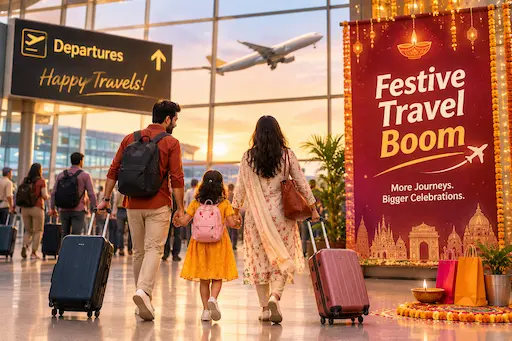
From Bookings to Experiences: What Is Driving India’s Festive Travel Boom?

As the festive season begins in India, the pace of traveling picks up. With an increase in domestic travel by over 40%, there appears to be an increase in the interest in travel spots other than big cities and popular tourist destinations. Tourists today want to have vacations that not only offer sightseeing but also provide opportunities for adventure and interaction with local people. This shift also reflects changing holiday preferences. Rather than choosing destinations solely for their popularity, travellers are considering the kind of experience they can have, the time required to reach a place and whether it offers something different from their usual travel routine. Unlocking Opportunities for Tourism Sector Mrs Jyoti Mayal, Chairperson, Tourism & Hospitality Skill Council (THSC), says, “India’s festive travel boom reflects a shift in the way people are choosing to travel. The focus is gradually moving beyond simply booking a holiday to seeking experiences that are more meaningful, personalised and memorable. Travellers are increasingly exploring regional destinations, immersive cultural experiences, nature-led getaways and local cuisines. Technology and AI-powered travel tools are also making it easier for people to discover lesser-known destinations, compare options and plan holidays around their individual interests.” She also highlights that improved connectivity and the growing popularity of shorter, more frequent breaks is opening up new opportunities for India’s tourism sector. The next phase of growth will depend not just on attracting more travellers, but on creating distinctive experiences that encourage them to explore more, stay longer and engage more deeply with the destinations they visit” Hospitality takes centre stage in emerging markets As interest in smaller destinations grows, the quality of accommodation is becoming an important part of the travel experience. Travellers may be willing to explore unfamiliar places, but their expectations around comfort, cleanliness, safety and service remain unchanged. They also look for convenient access to local attractions and reliable information about the destination. For hotel operators, this creates an opportunity as well as a challenge. They need to provide consistent service standards while ensuring that guests experience the character of the place they are visiting. According to Sandeep Basu, CEO of OPO Hotels & Resorts, “Today, travelers may seek off-the-beaten-path destinations, but their standards for comfort, reliability and service remain uncompromised. The real art of regional hospitality lies in delivering seamless excellence while authenticating the local character, transforming a hotel from just a place to stay into a gateway for local discovery.” The opportunity extends beyond leisure travel Not every emerging destination depends entirely on holidaymakers. Smaller cities can also attract business travellers, professionals, families visiting relatives and people travelling for local events. This mix can help create a more consistent demand for accommodation, beyond the festive and holiday periods. The availability of quality accommodation can influence how comfortably visitors plan their stay and whether they consider returning. Samraat, General Manager of Laa Montre Collection Hotels & Resorts, emphasises, “Emerging hubs like Meghalaya, Spiti, Andaman, Rajasthan and Himachal Pradesh prove that regional travel is driven by everyday economic momentum, from corporate business to family visits rather than seasonal tourism. The real growth opportunity lies in building dependable, high-quality infrastructure that matches this year-round demand and puts tier-2 and tier-3 markets firmly on India’s hospitality map.” Can festive interest translate into year-round demand? Travellers are experimenting with new destinations and considering places they may not have explored earlier. However, it takes much more than mere seasonal campaigns to keep up with the level of excitement. The reason for tourists to make repeated visits is essential to sustain the interest. Cultural elements, better access to unconventional places through improved infrastructure, and the experience that the destination offers may be considered to attract visitors for multiple trips. The prospects for future success of the new destinations depend a lot on the way local infrastructure and local hospitality industries can respond to the changing needs of the tourist. Connectivity might bring them in, but proper facilities will decide whether they come back or not.

Blog

The People Behind India’s Luxury Travel Boom, Adevo Academy

1. “The Difference Between a Memorable Holiday and a Forgettable One Is Never the Marble Floors” By Krishna Shantakumar, Co-Founder, Adevo Academy Thirty years behind the pass at South India’s most celebrated restaurant concepts, including The 13th Floor and ASEAN On The Edge, taught Krishna one thing: the guest experience is decided in the back of house, not the lobby. A personal, narrative piece on what makes five star service feel effortless and the unglamorous training that produces it. 2. “I Left the Taj to Fix What the Taj Never Could” By Rashmi Koppar, Co-Founder, Adevo Academy Former Taj and Oberoi trainer, then Deputy Registrar at Ramaiah University, Rashmi Koppar walked away from institutional prestige to build something the hotel chains had never prioritised: a genuine management development system for mid level hospitality professionals. A first person piece on ambition, frustration, and building something from scratch. 3. “India’s Luxury Hotels Are Filling Up Faster Than Ever. The People Running Them Are Not Ready.” By Brendon Pereira, Co Founder and CEO, Adevo Academy Ex CFO of an NSE listed hospitality company, IIM Ahmedabad alumnus, and with 30 years in operations, Brendon makes the case, with data and candour, that India’s travel boom is running ahead of its management infrastructure, and what that means for the guest experience your readers are paying a premium for. INDUSTRY STORY ANGLES 4. “India’s 50,000 New Hotel Rooms Have a Problem Nobody Is Talking About at Check In” India’s hotel pipeline is the fastest growing in Asia. What’s not keeping pace is the mid management layer that determines whether brand standards are actually delivered. A reported piece on India’s hospitality supervision gap, anchored by Adevo’s data and client work across South India. 5. “Why Your Resort Holiday Feels Different Every Time You Visit” The inconsistency that frustrates repeat travellers isn’t about chefs or GMs. It’s about the 200 untrained decisions made daily by supervisors who were never taught to lead. A piece your readers will recognise immediately from their own travel experiences. 6. “The Gen Z Hotel Worker Who Quit in 60 Days” India’s luxury hospitality is haemorrhaging its youngest staff at rates the industry is only beginning to acknowledge. This is not a Gen Z problem. It is a management problem, and it is directly affecting the guest experience your readers expect. FOUNDER PROFILE (suitable for a long form profile or dual or triple interview) 7. “Three Hospitality Veterans With 87 Combined Years Are Teaching India’s Hotels How to Grow Up” Brendon Pereira (IIM Ahmedabad, ex CFO), Krishna Shantakumar (30 years in F&B operations across South India), and Rashmi Koppar (Taj, Oberoi, Ramaiah University): how three people who spent their careers inside India’s finest hospitality institutions decided the industry needed to be rebuilt from the management layer up. A story about ambition, institutional frustration, and what it takes to train the people who train India’s hospitality workforce.

Blog

GNTO India Builds on Market Growth with November Roadshow and Year-End Campaigns

The German National Tourist Office, India is building on positive market momentum with its ongoing India Roadshow and a series of campaigns designed to inspire travel to Germany. These activities follow the successful GNTB India Digital Travel Knowledge Tour, held in Delhi and Mumbai which brought together decision-makers from the German tourism sector and India’s travel, technology and lifestyle industries. Strong participation, a positive response and valuable exchanges throughout the programme highlighted opportunities for closer collaboration, particularly as digital platforms, artificial intelligence and changing consumer preferences reshape travel planning and booking. India: A Growing Market for Destination Germany India continues to offer significant potential for German inbound tourism, supported by rising purchasing power and strong travel intentions. According to MMGY figures cited by the GNTB, planned annual holiday budgets among Indian outbound travellers are set to rise from 4,536 to 5,154 US dollars indicating growing willingness to invest in travel experiences. India is Germany’s fourth-largest overseas source market, while Germany ranks third among European destinations for Indian visitors, after the UK and France. This positive trend continued in 2026: from January to August, overnight stays from India reached 604,102, up 3.1% compared with the same period in 2025, according to the Federal Statistical Office. Building on these strong travel intentions, the current India Roadshow in Delhi, Ahmedabad, Bengaluru and Mumbai will connect German tourism partners with Indian travel agents and tour operators, strengthening business relationships and providing fresh inspiration for travel to Germany. “Indian travellers are increasingly looking for holidays that combine discovery with memorable experiences, and Germany has so much to offer—from regional cuisine and romantic escapes to festive winter traditions. Our year-end campaigns will bring these experiences closer to Indian audiences, while our upcoming roadshow will strengthen collaboration with the travel trade to turn this interest into inspiring holiday itineraries,” said Romit Theophilus, Director, German National Tourist Office, India. Inspiring Travel Through Focused Campaigns The Culinary Germany campaign invites visitors to discover regional specialities and local food traditions, while Honeymoon & Wedding highlights romantic journeys through picturesque towns, castles and scenic landscapes. “Next Stop: Travel Destination Germany” brings these diverse experiences together to inspire travellers’ next German holiday. As the festive season approaches, Season’s Greetings will spotlight Christmas markets, seasonal cuisine and winter breaks. From Nuremberg and Dresden to Frankfurt and Stuttgart, travellers can combine festive traditions with shopping, cultural visits and relaxing spa stays.

Blog

ixigo strengthens its OTA market position as per VIDEC report

ixigo Group has strengthened its position as India’s second-largest online travel agency (OTA) by gross booking value (GBV), with an 11% share of the Indian OTA market in FY26, according to VIDEC’s India Travel Market Opportunity Study, FY23–FY28. The study pegs the Group’s GBV at ₹18,690 crore in FY26, up from ₹14,970 crore in FY25 (~25% YoY growth), with its overall OTA market share increasing from 9.9% to 11%. The findings highlight ixigo Group’s continued leadership in OTA rail bookings, growing presence in air travel and strong position in intercity bus bookings. Strengthening leadership and growth in key business verticals According to VIDEC, ixigo Group’s share of India’s OTA rail market increased to 63.5% in FY26 from 60.4% in FY25. The Group’s rail GBV rose to ₹8,280 crore from ₹7,410 crore over the same period, reinforcing its position as the largest player in the segment through ixigo Trains and ConfirmTkt. As per ixigo’s recently disclosed Q2 numbers, its market share among OTAs in train bookings has further grown to 64% as of September 2026.  These market shares relate specifically to the OTA/B2C rail booking segment, which forms part of the broader Indian rail market. The study reinforces ixigo as the fastest-growing air OTA for the second consecutive year, highlighting its ability to leverage its large rail and bus user base to expand in air travel, with ixigo identified as India’s third-largest air OTA. Its share of the OTA air market rose to 8.3% from 6.7% in FY25. Its air GBV increased to ₹7,510 crore from ₹5,650 crore during this period. AbhiBus (ixigo Group’s bus business) retained its position as the second-largest player in India’s OTA intercity bus segment. As per the study, the Group’s market share increased to 15.1% in FY26 from 13.8% in FY25, while its bus GBV rose to ₹2,620 crore from ₹1,800 crore (45% YoY growth) A growing digital travel opportunity The report highlights the role of OTAs in aggregating fragmented bus supply and digitising small and mid-sized private operators, and it expects the online bus booking market to grow at 26%+ over the next two years. According to VIDEC, India’s OTA market reached ₹1,70,300 crore in FY26, up from ₹1,51,400 crore in FY25, a growth of 12.4%, providing a growing opportunity for digital travel platforms. The study also points to significant potential in lodging, comprising hotels and alternative accommodation. India’s online lodging market is projected to reach ₹81,000 crore by FY28, representing a 23.6% CAGR in rupee terms over FY23–FY28. This expanding market provides a broader industry backdrop to ixigo’s presence in hotel bookings. Rajnish Kumar, Co-Founder & Group Co-CEO, ixigo & Aloke Bajpai, Co-Founder & Group CEO, ixigo, said, “Our growing presence across hotels, rail, air and bus travel reflects the trust travellers place in ixigo Group. We have built deep relationships with users through the ixigo, ConfirmTkt and AbhiBus brands, and our journey on hotels has just gotten started. Our focus remains on leveraging technology and AI to build the best peace of mind apps for travellers.” Virendra Jain, Co-founder and CEO, VIDEC, said, “India’s OTA market reached ₹1.7 lakh crore in FY26, reflecting the growing role of digital platforms in how travellers discover and book travel. ixigo Group’s performance demonstrates its ability to leverage product, technology and a peace-of-mind product stack to leapfrog growth across the segments it operates in. It continues to dominate the rail OTA market, has expanded its share in the intercity bus OTA market and has become India’s fastest-growing air OTA. Its ability to grow the air, bus  travel & hotels business stands out, while its hotel business offers it further room for growth & diversification.”

Blog

Thomas Cook India & SOTC Travel Curate Holidays Combining Year-End Celebrations with Immersive Experiences

New Year travel is evolving beyond the traditional midnight countdown, with Indian travellers increasingly looking to combine end of year celebrations with distinctive destination experiences. From spectacular fireworks and summer adventures in Australia and New Zealand to winter festivities in Europe, cultural celebrations across Asia and immersive cruise journeys, travellers are exploring new ways to celebrate the year gone by and welcome the year ahead. Recognizing this growing trend, Thomas Cook (India) Limited, India’s leading omnichannel travel services company, and its Group Company, SOTC Travel, have curated a portfolio of domestic and international holidays spanning Australia and New Zealand, Europe, Asia, the Middle East, India and the Arctic, alongside luxury ocean and expedition cruises. Thomas Cook India and SOTC Travel offer a range of year-end holidays through ready-to-book, air-inclusive group tours and customised holidays tailored to individual preferences. Spanning domestic and international destinations, the portfolio brings together seasonal highlights and distinctive experiences for families, couples, friends and multi-generational groups, with options ranging from New Year celebrations and sightseeing to cultural discovery and immersive destination experiences. Australia & New Zealand: A summer New Year with immersive experiences For travellers seeking a different way to ring in the New Year, Australia and New Zealand offer the appeal of summer holidays, scenic landscapes and outdoor adventures. Australia’s iconic cities come alive with spectacular fireworks and waterfront celebrations. In Sydney, travellers can enjoy an elevated New Year’s Eve experience at Water’s Edge Sydney, combining a spectacular harbour setting with a bespoke New Year’s Eve menu, a four-course gourmet dinner, a late-night snack station and a 6.5-hour beverage package featuring champagne on arrival, wine, beer, soft drinks and juices. Melbourne offers a lively waterfront celebration in South Wharf, with a DJ, a vibrant party atmosphere and views of the midnight fireworks over the Yarra River, while the Gold Coast brings the excitement of New Year’s Eve at Surfers Paradise. Combination festive departures are also available, offering travellers more ways to explore Australia over the holiday season. New Zealand complements the experience with its summer landscapes, outdoor pursuits and scenic escapes, making the region an appealing choice for travellers looking to combine year-end celebrations with a longer holiday. Europe: Winter Festivities, Alpine Escapes and the Northern Lights Europe offers a distinctive year-end atmosphere, with festive markets, illuminated streets, seasonal gastronomy and celebrations across some of its most iconic cities. Destinations such as London, Paris, Vienna, Prague and Germany’s historic towns bring together Christmas markets, cultural attractions and winter experiences, while Switzerland and Austria offer snow-covered Alpine landscapes, scenic rail journeys, mountain stays and winter sports. Greece provides a different perspective, with its historic landmarks, coastal settings and cultural experiences adding variety to multi-country European itineraries. For travellers seeking a more extraordinary winter escape, the Arctic offers the opportunity to witness the Northern Lights across destinations such as Finland, Norway, Sweden and Iceland. Beyond Aurora viewing, experiences include husky and reindeer sledding, snowmobile excursions, snowshoeing and stays in distinctive accommodation such as glass igloos and Arctic cabins. These journeys combine seasonal landscapes with immersive experiences, making them an appealing option for couples, families and travellers seeking something beyond conventional sightseeing. Asia and Beyond: Cultural Discoveries and Distinctive Celebrations Across Asia, year-end travel brings together cultural traditions, vibrant city experiences, local cuisine and opportunities to explore destinations at a more immersive pace. Japan offers a distinctive New Year experience, with traditional temple visits and Hatsumode, the first shrine or temple visit of the year, alongside its contemporary city attractions. Across Thailand, Malaysia, Indonesia, Singapore and Vietnam, New Year celebrations take on a more festive and social character, with gala dinners, entertainment and city celebrations forming part of the holiday experience. Multi-country combinations such as Singapore-Malaysia and Vietnam-Bali further allow travellers to turn the year-end break into a longer holiday. Dubai and Abu Dhabi offer another popular combination of festive celebrations, dining, entertainment and spectacular city experiences, while Azerbaijan and Georgia bring together winter landscapes, heritage, local cuisine and cultural exploration along with New year celebrations. Domestic Holidays: Premium Island Escapes, Scenic Getaways and Spiritual Experiences For travellers looking to celebrate the year-end closer to home, India offers a diverse range of holiday experiences. Lakshadweep is emerging as an attractive choice for travellers seeking a premium island holiday without travelling overseas. To make the destination more accessible, Thomas Cook India and SOTC Travel have introduced direct charter flights from Bengaluru to Lakshadweep for the year-end season, offering travellers a convenient and seamless way to reach the island destination. Bhutan is another highlight, with special charter departures from Mumbai offering convenient access to the Himalayan kingdom and its monasteries, mountain scenery and distinctive cultural experiences. Other popular destinations include the Andamans, Kerala, Rajasthan and Sri Lanka, offering a choice of island holidays, backwater experiences, heritage trails and scenic escapes. Spiritual tourism is also gaining momentum, with travellers seeking meaningful, faith-led experiences across India to end the year. Pilgrimage circuits and temple towns such as Char Dham, Mahakaleshwar Temple in Ujjain, Tirupati and Vaishno Devi continue to attract devotees looking to combine travel with prayer, reflection and spiritual discovery. Celebration at sea Cruises offer an alternative way to combine New Year celebrations with destination exploration, bringing accommodation, dining, entertainment and multiple destinations together within one journey. Onboard gala dinners, live entertainment, festive celebrations and ocean views create a memorable setting for welcoming the New Year, while port calls offer opportunities to explore destinations along the route. From Southeast Asian and Middle Eastern itineraries to Mediterranean voyages, Australia–New Zealand sailings and premium expedition cruises across the Arctic and Antarctica, travellers can choose from a variety of cruise experiences suited to different interests. Mr. Rajeev Kale, President & Country Head – Holidays, MICE, Visa, Thomas Cook (India) Limited, said, “New Year travel is increasingly about combining the excitement of celebration with the opportunity to discover a destination and its experiences. Indian travellers are looking to make the occasion memorable through distinctive experiences, whether it is watching the New Year fireworks over Sydney


Blog

Aionos Appoints Hemant Lamba as Chief Business Officer to Accelerate Global Growth

Hemant brings more than 30 years of global leadership in technology services and large-scale digital transformation. He joins from Inetum, where as CEO of Inetum Solutions he led a 7,000-strong organisation and built a next-generation services business combining sector expertise with AI-led propositions. Earlier, he held senior leadership roles at Infosys, Accenture, IBM and Cognizant, leading strategic sales and large deals and driving turnarounds and growth across Europe, North America and Asia-Pacific. Commenting on the appointment, CP Gurnani, Co-Founder and CEO, Aionos, said, “We are delighted to welcome Hemant to Aionos. Hemant has built and scaled global technology businesses and earned the trust of enterprise leaders across geographies. As organisations move AI from pilots into production, and demand for enterprise-grade, AI-native services grows, he will lead our growth, deepen our client and partner relationships, and take Aionos into new markets.” Speaking on his appointment, Hemant Lamba, Chief Business Officer, Aionos, said, “As enterprises move from experimenting with AI to embedding it in their operations, they need partners who can make it work inside their business, securely and at scale. Aionos brings deep industry experience, its own AI platforms and proven delivery for some of the most demanding operations anywhere. My priority is to bring all of that to our clients as one Aionos, and shape the next phase of the company’s growth.”

Blog

IntrCity SmartBus announces estimated annual saving of 3 crore litres of water through bio-washrooms

IntrCity SmartBus, a tech-enabled intercity mobility platform, today announced an estimated annual saving of 3 crore litres of water through the use of bio-washroom technology across its network. With nearly 1 crore passengers travelling on its buses every year, covering an average distance of around 600 km per journey, the company is using the technology to improve onboard washroom facilities while reducing water consumption and addressing operational challenges around maintenance and waste management. IntrCity SmartBus currently offers onboard washrooms across more than 95% of its buses. As the company scaled the availability of washrooms across its network, it also focused on addressing some of the common challenges associated with onboard facilities, including cleanliness, odour, fresh-water consumption and waste disposal. Bio-washrooms use approximately 2 litres of water per flush, compared with around 4–5 litres in conventional toilets. Based on an estimated average of one washroom use per passenger per journey, this represents a saving of approximately 3 litres of water per passenger. With nearly 1 crore passengers travelling with IntrCity SmartBus annually, the company estimates that the use of bio-washrooms can help save around 3 crore litres of water every year. Manish Rathi, Co-founder & CEO of IntrCity SmartBus, said, “As we continue to scale our intercity network, we are looking at the different aspects that contribute to a more consistent passenger experience. Onboard washrooms are an important requirement for long-distance journeys, and our focus has been to make this facility more reliable while addressing the operational challenges that come with maintaining it across routes. The use of bio-washrooms allows us to reduce water consumption while improving the overall functionality of the facility. At our scale, these interventions can create a meaningful impact across both passenger experience and resource efficiency.”

Blog

Meghalaya Tourism takes its Culinary Heritage across India through Seeti In Your City and Fire & Feast Festival

Meghalaya Tourism and Meghalayan Age, in collaboration with Seeti Movement, a curated dining experience that brings together chefs, traditional cooks and select audiences to celebrate Meghalaya’s culinary traditions, are taking the state’s culinary heritage across India from October 2026 to February 2027 through two distinct initiatives: Seeti In Your City and Fire & Feast Festival. Together, the two initiatives will have 14 Food Events across India to introduce new audiences to Meghalaya’s indigenous ingredients, culinary traditions and food communities, while creating opportunities for cultural exchange and positioning the state as a distinctive culinary destination. The programme opens on 22 October 2026 in Bengaluru with Tribal Expressions by Seeti In Your City, an Intimate Culinary Experience at Tijouri, Radisson Blu Atria, Bengaluru. Celebrating the indigenous food cultures of the Khasi, Garo and Jaintia tribes, the evening will bring guests closer to Meghalaya’s culinary heritage through traditional ingredients, regional cooking techniques and the stories behind its food. Following the Bengaluru opening, Seeti In Your City will travel to Delhi NCR, Mumbai and Kolkata, alongside further editions planned across the country. Fire & Feast Festival takes a different approach, bringing the experience to a wider public through a large-format Food Festival centred on barbecue, live-fire cooking, music and community. While distinct in format, both initiatives share a common ambition: to take Meghalaya’s food culture beyond the Northeast and build lasting connections with audiences across India. Fire & Feast Festival will extend the initiative through public food festivals in Hyderabad, Bengaluru, Goa, Mumbai and Gurgaon. Dr. Vijay Kumar, Commissioner and Secretary, Department of Tourism, said, “By taking Meghalaya’s culinary heritage to cities across India, we are creating a platform for cultural exchange and greater recognition of our indigenous ingredients, traditional knowledge and local talent. We see this as an opportunity to strengthen the state’s visibility while ensuring its communities remain central to the story.” The overall programme across selected city in India will bring together an accomplished line-up of Meghalayan Chefs and Culinary Practitioners, who will participate in Seeti in your City and Fire and Feast Festival. First Runner-Up of MasterChef India Season 8 and Cultural and Culinary Ambassador of Meghalaya, Chef Nambie Jessica Marak, along with other renowned local Chefs such as Chef Ahmedaki Laloo, Benny Paia Dondor Wankhar, Adonijah Lyngdoh, Reuben Zamal Sooting and Fufu Pamei will bring the Meghalayan Culinary experience to life. The Fire and Feast festival will include Pitmaster and Barbecue Specialist Christopher Fernandes and Vasco Alvares; and Restaurateur and Hospitality entrepreneur Rizwan Amlani. Famous restaurants Rynsan and Shad Skye, alongside traditional cooks from Mylliem area, will also be part of exclusive showcases celebrating Meghalaya’s distinctive ingredients, regional flavours and culinary traditions. Sid Mewara of The Big Forkers said, “The idea is to take Meghalaya beyond a destination people admire from afar and introduce them to its food, its people and the stories behind both. Seeti In Your City creates a more intimate setting for discovery, while Fire & Feast Festival opens that experience to a wider public. Together, they give the state’s culinary traditions a platform across India.” Priyadarshini Raje Scindia said, “Food is one of the most personal ways to understand a place. In Meghalaya, culinary traditions are closely tied to the land, the communities and the knowledge passed down through generations. Through Seeti In Your City and Fire & Feast Festival, we hope to bring these traditions to audiences across India and give greater recognition to the people who have kept them alive. I hope these experiences encourage people to look beyond what is familiar to them and discover Meghalaya through its food, its people and their stories.”

Vibrant Colours is an Indian registered publication catering to the travel, tourism, embassy and hospitality sector. The magazine is published under the global publication group  Prime Communication from New Delhi, India. Launched in 2019, the magazine was conceived with a vision to serve and celebrate the ever-growing travel trade and tourism industry across India and beyond.

Copyright © 2019-2026 Vibrant Colours. All rights reserved.

Scroll to Top