


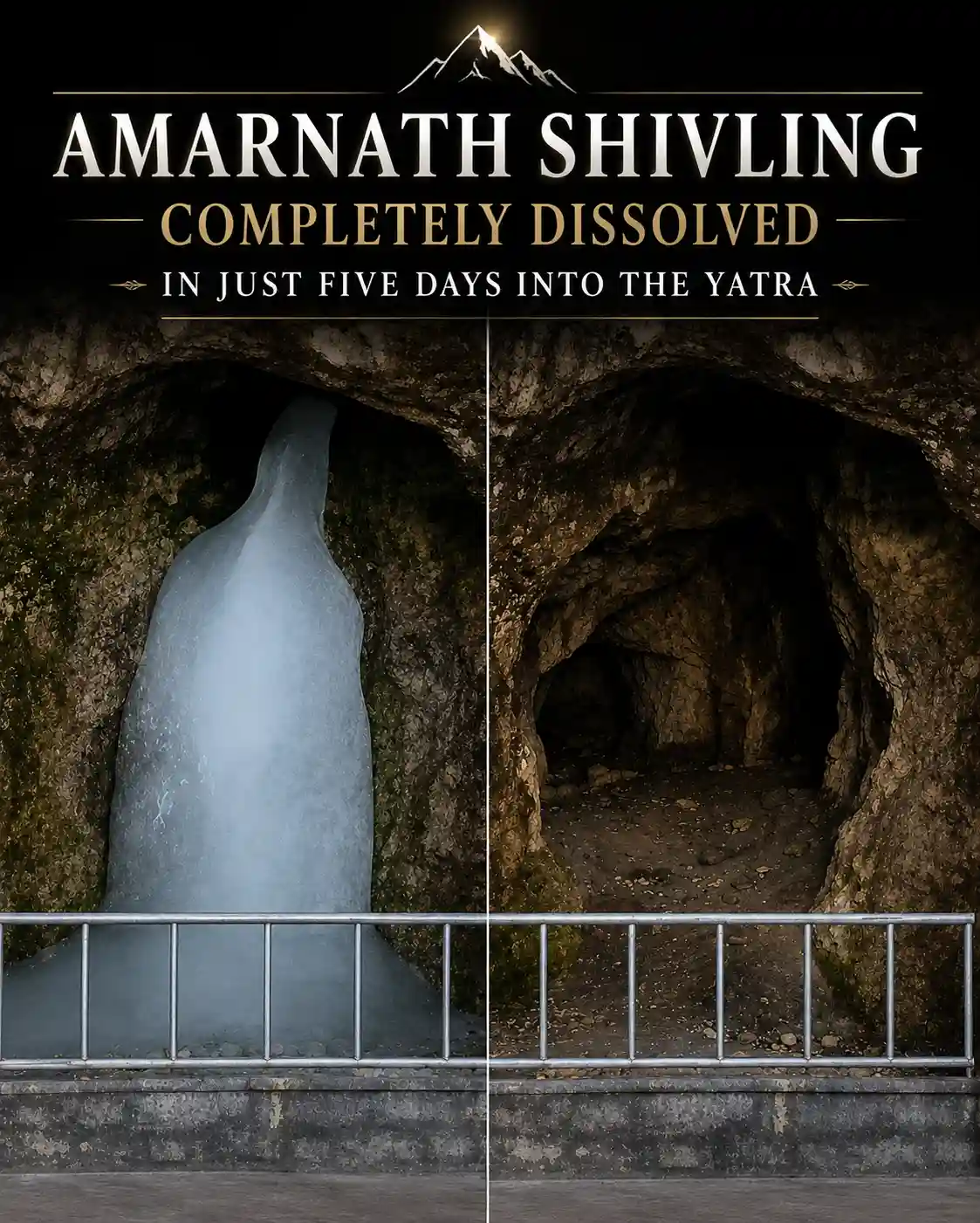
Barely a week into the Amarnath Yatra 2026, the sacred Amarnath Ice Shivling — the naturally forming ice lingam worshipped as Lord Shiva inside the Amarnath Cave — has almost entirely disappeared. Photographs from the shrine released around July 6–7 show a formation that stood nearly seven feet tall in May reduced to little more than a faint trace, prompting fresh debate over whether global warming is now reshaping one of Hinduism’s most revered pilgrimages.
What’s Happened So Far
The ice Shivling was recorded at close to seven feet in height in a Border Security Force photograph taken on May 23. By July 6, images showed the formation had shrunk to roughly a foot, and by July 7, officials and visiting devotees described it as having diminished by close to 90–99 percent, leaving only a faint outline in parts of the cave.
This is not an isolated year. According to shrine officials and repeated recent reports, the ice formation has failed to last beyond a single week for three years running, a sharp contrast to earlier decades when the Shivling could remain intact for over a month, sometimes lasting close to 45 days in years with heavier winter snowfall.
Despite the melt, the 57-day yatra — which began July 3 and runs through August 28 — is continuing without disruption. Pilgrims are still making the trek in large numbers, with more than a lakh devotees having performed darshan in the shrine’s first week alone.
Why Devotees Are Reacting
For many pilgrims, seeing the ice lingam in its full form is central to the spiritual experience of the yatra, and the rapid melt has left a mix of disappointment and quiet acceptance among those making the difficult climb. Some devotees who completed darshan this week said only a faint trace of the formation remained by the time they reached the cave, while others noted that faith in Baba Barfani does not depend on the physical size of the ice. A few pilgrims have suggested the yatra dates should be moved earlier, into mid-June, to give more devotees a chance to see the Shivling before it shrinks.
Could Global Warming Be Behind It?
Climate scientists and shrine experts point to a combination of factors rather than a single cause. The ice Shivling forms when water seeping through the cave roof freezes in sub-zero conditions through winter and spring; its size in any given year depends on how much snow fell that winter, how cold the cave stays, humidity levels, and airflow inside the chamber.
This year, experts cite a mix of contributing factors: warmer-than-usual regional temperatures, reduced winter snowfall feeding the cave’s water supply, and recurring early-summer heatwaves across the Kashmir Valley. Some also point to windblown dust settling on nearby glaciers and snowfields, which darkens the surface and speeds up melting by absorbing more heat. The sheer scale of pilgrim footfall inside a naturally cold, enclosed cave has also been flagged as a possible amplifying factor, since body heat and increased humidity from large crowds can accelerate melting in an already fragile microclimate.
Broader regional data lends some weight to the climate argument — the Himalayan region has been documented to be warming faster than the global average in recent years, a trend that affects glacier behaviour and snowfall patterns across Jammu and Kashmir. That said, experts are cautious about drawing a direct one-to-one line from global warming to this particular event, noting that a detailed scientific study of the cave’s specific conditions this year would be needed before attributing the melt to any single cause.
Does This Affect the Ongoing Yatra?
So far, the Shrine Board has not indicated that the melted Shivling will change the yatra’s schedule or arrangements in any way. The pilgrimage continues on both the Baltal and Pahalgam routes under heavy security, with langars, medical camps and RFID-based registration systems functioning as planned. For most devotees, the cave itself — not just the ice formation inside it — remains the primary object of pilgrimage, and officials say footfall has, if anything, remained higher than in previous years.
The Bigger Picture
What’s emerging is a pattern rather than a one-off event: three consecutive years of an ice Shivling that melts within days rather than weeks. Whether this points to a genuine long-term shift in the cave’s winter and spring conditions, or simply a run of warmer years, is something only sustained observation — and the kind of detailed glaciological study experts are calling for — can answer. For now, the yatra continues, the crowds keep climbing, and the story of a melting ice lingam has become as much a talking point as the pilgrimage itself.
Frequently Asked Questions
Q1. How tall was the Amarnath ice Shivling this year before it melted? It measured close to seven feet in a BSF photograph taken on May 23, 2026, before shrinking by an estimated 90–99 percent within the first week of the yatra.
Q2. Has the ice Shivling melted early before? Yes. Shrine officials and recent reports note that for the past three years, the formation has not lasted beyond about a week, compared to longer durations in earlier years.
Q3. Is the Amarnath Yatra 2026 affected by the melting? No official change has been announced. The 57-day pilgrimage, running from July 3 to August 28, continues as scheduled on both the Baltal and Pahalgam routes.
Q4. What do experts say is causing the early melt? Experts point to a mix of warmer regional temperatures, reduced winter snowfall, early heatwaves, dust darkening nearby snow surfaces, and heat from large numbers of pilgrims inside the cave.